Washington utility partners with local school to generate renewable power from water system
Key Highlights
- The project utilizes HydroXS micro-hydro technology to generate approximately 300,000 kWh annually from pressure energy in the water system.
- A partnership with the local school district enables net metering, reducing energy costs and supporting educational initiatives on renewable energy.
- Funding was secured through state grants, federal incentives, and private funds, ensuring project viability without impacting ratepayers.
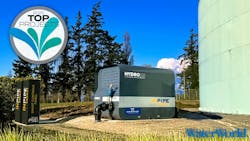
Location: Mount Vernon, Washington
Facility size: 1,450 GPM
Budget cost: $1,000,000
Manufacturer: HydroXS
Skagit Public Utility District (PUD) has completed a first-of-its-kind community-scale energy recovery project that captures previously wasted pressure energy in its drinking water system and converts it into clean electricity. The project—installed at the 9th and Highland Reservoir site in Mount Vernon, Washington—pairs innovative micro-hydro technology with a unique community partnership model that could be replicated across the nation’s nearly 50,000 water utilities.
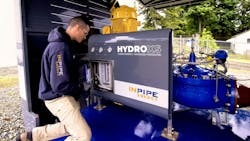
The effort began in 2011 when Skagit PUD launched a systemwide assessment to evaluate electrical generation potential from pressure-reducing locations in its distribution network. One of the most promising opportunities was the 9th and Highland site, where water entering the district’s 5-million-gallon storage tank drops from a hydraulic grade line (HGL) of 459 feet to 219 feet. Traditionally, a mechanical pressure reducing valve (PRV) would dissipate this excess pressure through heat, noise, and vibration. Instead, Skagit PUD selected the HydroXS system from InPipe Energy, an “intelligent PRV” that provides consistent downstream pressure while using the pressure drop to generate renewable electricity.
“Investigate all areas of your water system where you use PRVs to see if this kind of solution would work for you, because the technology has improved to the point where you don’t need tremendous pressure differentials, and the equipment has a smaller footprint than you expect,” said Skagit PUD General Manager George Sidhu.
The system is expected to produce roughly 300,000 kWh per year, preventing more than 9.3 million pounds of carbon emissions over its 30-year lifespan. As the largest water provider in Skagit County—serving 116,000 people—Skagit PUD sees the project as a replicable model for other utilities exploring ways to extract greater value from existing infrastructure.
Partnership approach makes the project financially viable
A key breakthrough occurred when Skagit PUD formed a partnership with the adjacent Mount Vernon School District. Because the utility cannot sell power and the reservoir site itself had little electrical demand, the district became an ideal partner with substantial on-campus energy needs. Through a net metering arrangement approved by Puget Sound Energy (PSE), electricity generated by the system is fed back onto the grid, offsetting the school’s energy bills. The project also funded installation of two electric vehicle charging stations at the high school, providing visible proof of local clean energy production.
The collaboration supports the district’s sustainability goals while offering students hands-on learning opportunities tied to renewable energy and water system operations.
Funding, design and construction challenges
Implementing the new system required navigating complex funding and technical hurdles.In 2023, the Washington State Department of Commerce awarded the project $598,000 through its Clean Energy Fund 5 Rural Clean Energy Program. The district and its partners assembled the remaining funding through TransAlta’s Coal Transition Fund, IRS incentives, and Inflation Reduction Act provisions for U.S.-made technologies—allowing the project to move forward without impacting ratepayers.
The technical integration was equally complex. Replacing the mechanical PRV required the turbine system to maintain precise pressure control for the reservoir while capturing energy from consistent, high flows. Skagit PUD, InPipe Energy, and Grundfos developed customized pressure management strategies, while PSE conducted rigorous electrical safety and grid interconnection testing.
Construction required careful operational planning to maintain continuous water service, including bypass procedures and on-site engineering to navigate aging infrastructure installed decades earlier. Commissioning revealed initial challenges with noise and lower-than-expected output, which were resolved through equipment adjustments and several days of system calibration.
Long-term value

Today, the energy recovery system operates about 90% of the time with backup PRV support, generating reliable clean power and helping extend the life of existing infrastructure. The project reduces emissions, lowers energy costs for the school district, and demonstrates how utilities can derive new community value from long-standing water assets.
With its successful launch, Skagit PUD now has established procedures and performance baselines for evaluating additional micro-hydro opportunities across its network—offering a potential model for utilities nationwide seeking cost-effective ways to integrate renewable energy directly into water operations.



About the Author

Alex Cossin
Associate Editor
Alex Cossin is the associate editor for Waterworld Magazine, Wastewater Digest and Stormwater Solutions, which compose the Endeavor Business Media Water Group. Cossin graduated from Kent State University in 2018 with a Bachelor of Science in Journalism. Cossin can be reached at [email protected].